

Enhance Customer Engagement with Chatbots & Virtual Assistants
Foundation of Our Approach
Customer satisfaction is key to seamless business operations, and AI-driven chatbots play a crucial role in achieving it. By providing instant responses and 24/7 availability, these tools efficiently handle large volumes of inquiries while managing multiple interactions simultaneously. This automation not only enhances customer experience but also frees up human agents to focus on more complex business tasks.In this use case, we have discussed an architecture that provides intelligent, personalized, and context-aware interactions with customers, enhancing user experience and ultimately driving conversions.
Key Elements Behind the Process
In this use case, we have discussed an architecture that provides intelligent, personalized, and context-aware interactions with customers, enhancing user experience and ultimately driving conversions.
The architecture supports scaling up and down based on demand, ensuring efficiency in handling large volumes of queries.
By leveraging AI-driven models, the chatbot provides quick and relevant responses.
The integration of AWS services ensures that data is stored and processed securely.
The modular design allows easy integration with existing enterprise applications.
The chatbot improves over time by utilizing stored embeddings for contextual conversations.
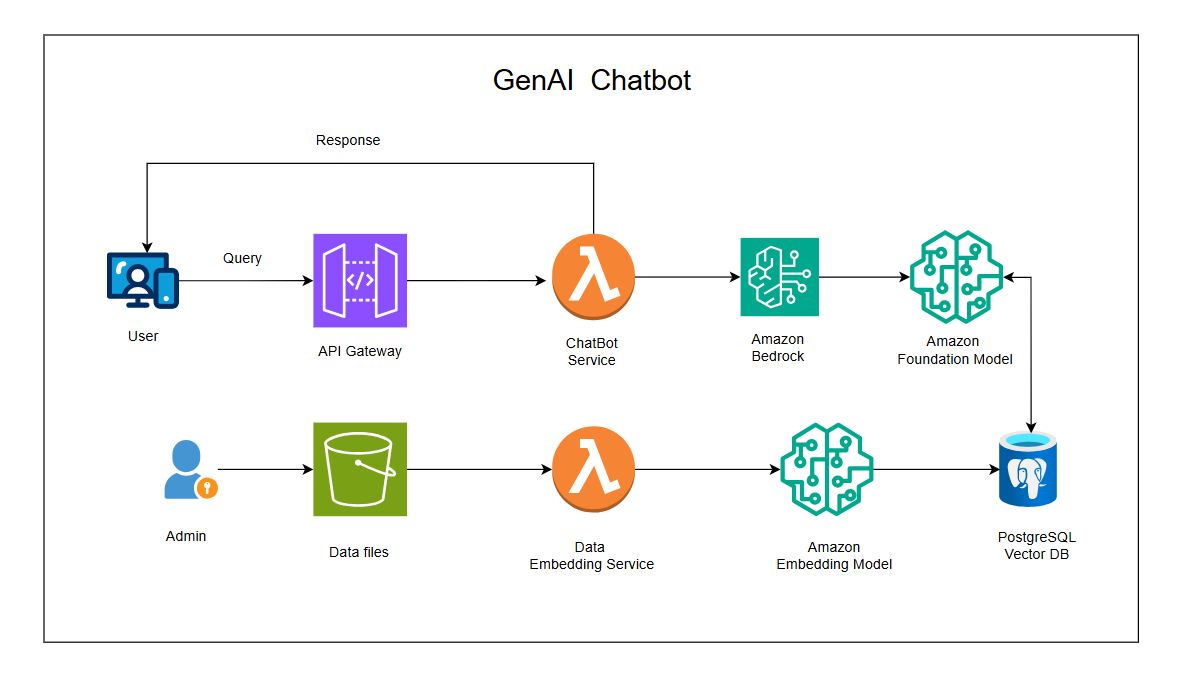
The following outlines the components and processes involved in this initiative.
Detailed Breakdown of the Process
The end-user interacts with the chatbot by sending a query through the application interface
Acts as the entry point for user requests. Routes incoming queries to the appropriate service.
A serverless function that processes user queries. Integrates with Amazon Bedrock to generate responses using a foundation model.
Provides access to foundation models for AI/ML tasks.Processes the query and generates responses based on the user input.
AI models accessed through Amazon Bedrock to handle natural language processing and generation tasks.
Responsible for uploading relevant data files for chatbot training or enhancements.
Stores the data files uploaded by the admin for further processing.
Converts raw data into embeddings using an Amazon Embedding Model. Prepares the data for storage in a vector database.
Generates vector representations (embeddings) of the data to enhance search and contextual responses.
Stores embeddings for efficient similarity search and retrieval.Enables the chatbot to provide context-aware responses based on past interactions or data.
How It Works
The user sends a query through the application, which is routed via the API Gateway to the Chatbot Service.
The Chatbot Service invokes Amazon Bedrock to process the query using an Amazon Foundation Model
The generated response is sent back to the user.
The admin uploads data files to the S3 Bucket.
The Data Embedding Service retrieves these files and generates vector embeddings using the Amazon Embedding Model.
The embeddings are stored in the PostgreSQL Vector Database.
When the chatbot processes a query, it can reference the vector database for context or historical data to enrich the response.
By leveraging the integration of AI-driven chatbots one can not only reduce customer waiting times but also reduce inefficiencies such as providing inaccurate answers.
Key to Business Success
Businesses worldwide are deploying chatbots and virtual assistants to solve queries faster and automate repetitive work.
Reduce customer wait times and create engaging customer interactions with intelligent solutions.
Lower operational costs, allowing teams to concentrate on complex issues that need human support.